Gulf Fritillary
Agraulis vanillae
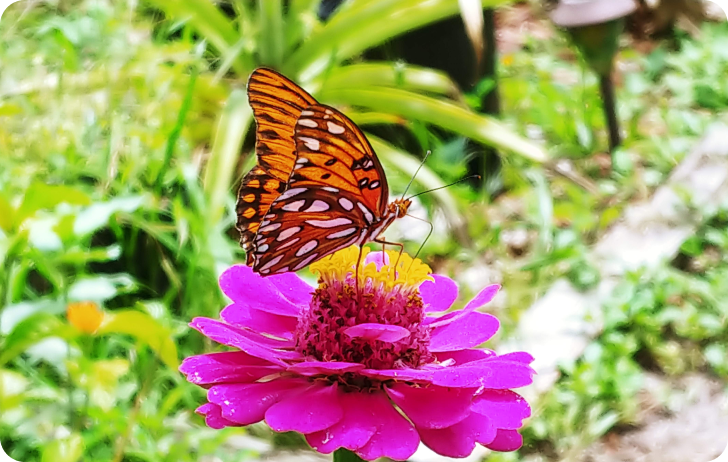
The Gulf Fritillary is a vibrant orange butterfly with bold black markings on its wings and stunning silver spots on its underside. Its long, slender wings and delicate body make it a graceful sight in gardens and meadows.
Distribution in Florida
Found throughout the southern United States, Central America, and parts of South America.
Where to Find Gulf Fritillary in Florida
Gulf Fritillaries can be found in a variety of habitats including fields, meadows, open areas, gardens, and roadsides, especially in the southern U.S. and Central America.
Lifecycle
Egg
The Gulf Fritillary begins its life as a tiny, yellow egg laid on the leaves or tendrils of passion vines. The eggs are spherical and about 1 mm in diameter. They hatch within 3 to 5 days, depending on temperature and environmental conditions.
Caterpillar
The caterpillar of the Gulf Fritillary is bright orange with black spines and white spots. It goes through five instar stages, growing larger with each molt. The caterpillar feeds exclusively on passion vine leaves, which provide toxins that make it unpalatable to predators.
First Instar
After hatching, the first instar caterpillar is tiny and pale yellow. It immediately begins feeding on passion vine leaves. Duration: 2–3 days.
Second Instar
In the second instar, the caterpillar develops its characteristic orange color and black spines. It grows rapidly and continues to feed voraciously. Duration: 2–3 days.
Third Instar
By the third instar, the caterpillar's spines become more pronounced and its body grows larger. It consumes more leaves to prepare for the next stage. Duration: 2–3 days.
Fourth Instar
In the fourth instar, the caterpillar reaches a significant size and begins to show more distinct markings. It continues to feed heavily. Duration: 2–3 days.
Fifth Instar
This is the final stage before pupation. The caterpillar reaches its maximum size, often up to 1.5 inches in length. It then seeks a sheltered spot to form its chrysalis. Duration: 3–4 days.
Formation of the Chrysalis
After the fifth instar, the caterpillar attaches itself to a sturdy surface using a silk pad. It forms a chrysalis that resembles a dried leaf or piece of wood, providing excellent camouflage.
The chrysalis stage lasts approximately 7 to 12 days, depending on environmental conditions.
What does the Gulf Fritillary chrysalis look like?
The chrysalis is brown and mottled, resembling a dried leaf or piece of bark. This camouflage helps protect it from predators during its vulnerable transformation stage.
How long does the Gulf Fritillary stay in the chrysalis?
The butterfly remains in the chrysalis for approximately 7 to 12 days, depending on temperature and humidity.
Adult Behavior
Lifespan
The adult Gulf Fritillary typically lives for 2 to 4 weeks, depending on environmental conditions and predation.
Feeding
Adults feed on nectar from a variety of flowers, including lantana, zinnias, and milkweed. They are also known to visit mud puddles to absorb minerals.
Mating and Reproduction
Males patrol for females, often near passion vines. After mating, females lay eggs on the leaves or tendrils of passion vines. The eggs hatch within a week, and the lifecycle begins again.
How to Tell Male from Female
Males are slightly smaller with more elongated wings, while females are larger with rounder wings. Females also tend to have more pronounced silver spots on the underside of their wings.
Migration
Gulf Fritillaries do not migrate long distances but may move locally in response to seasonal changes or food availability.
How to Attract Gulf Fritillaries to Your Garden
To attract Gulf Fritillaries, plant passion vines (their host plants) and nectar-rich flowers such as lantana, zinnias, and milkweed. Avoid using pesticides, as they can harm both caterpillars and adult butterflies.
Conservation Tips
Support Gulf Fritillary populations by planting native passion vines and nectar plants in your garden. Participating in citizen science projects can also help monitor butterfly populations and support conservation efforts.
Table of Contents
- Egg
- Caterpillar
- Chrysalis
- Adult Behavior
- How to Raise
Family:
Nymphalidae
Common Names:
Passion Butterfly, Silver-spotted Flambeau
Size:
Wingspan between 2.4 and 3.7 inches (60-95mm).
Host Plant:
Passion vines (Passiflora species)
Conservation Status:
The Gulf Fritillary is not currently listed as endangered or threatened. However, like all butterflies, they can be affected by habitat loss and the use of pesticides.
Did you know?
The caterpillars of the Gulf Fritillary consume passion vines, making them unpalatable to many predators due to the toxins they ingest.
How fast can a Gulf Fritillary fly?
Gulf Fritillaries have a rapid flight, often darting quickly from flower to flower.
Did you know?
The chrysalis of the Gulf Fritillary is unique in its appearance, often resembling a dried leaf or a piece of wood, providing excellent camouflage.
Predators and Threats
Birds, spiders, and praying mantises might prey on Gulf Fritillaries. However, their toxic nature due to passion vine consumption deters many potential predators.
Did you know?
The Gulf Fritillary is one of the few butterflies that can breed year-round in the southernmost parts of its range.