Monarch
Danaus plexippus
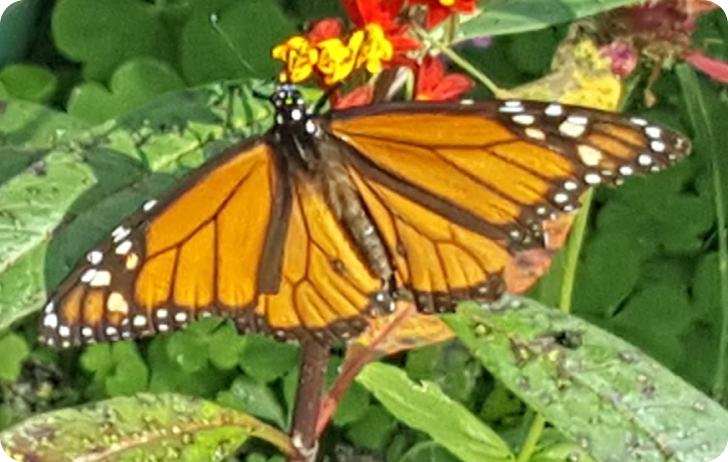
The Monarch Butterfly is perhaps the most well-known and recognized butterfly in North America. It is known for its striking orange and black wings and its incredible long-distance migration. The Monarch undertakes a multi-generational migration from Canada to Mexico and back.
Distribution in Florida
Found throughout North America, Central America, and northern parts of South America. They have also been spotted in parts of Europe, Australia, and other regions.
Where to Find Monarch in Florida
Monarchs can be found in a variety of habitats including fields, meadows, prairies, urban and suburban parks, gardens, and roadsides.
Monarch Butterfly Lifecycle
Egg
Monarch butterflies lay their eggs on the underside of milkweed leaves. These eggs are tiny, oval, and pale yellow. After about 4 days, the caterpillar will emerge from the egg.
Caterpillar
The Monarch caterpillar is easily recognizable with its striking pattern of black, white, and yellow stripes. As it grows, it will molt (shed its skin) several times. The caterpillar will continuously eat the milkweed leaves, storing the plant's toxins in its body, which will deter predators from eating it. It will grow rapidly reaching a length of about 2 inches.
Formation of the Chrysalis
Once the caterpillar is fully grown, it will find a sheltered spot to transform into a chrysalis. The green chrysalis will hang, secured by a silk thread, and over about 10 days, the caterpillar will undergo a metamorphosis into a butterfly.
Adult
After emerging from the chrysalis, the Monarch butterfly will pump blood into its wings to stiffen them. Once its wings are dry, the butterfly will be ready to fly. The adult Monarch's primary goal is to reproduce and lay the next generation of eggs.
Feeding
Adult Monarchs feed on the nectar from a variety of flowers, using their long, tube-like tongues called proboscises. While milkweed is essential for the caterpillars, adult Monarchs will feed on the nectar from various flowering plants.
Mating
Mating occurs in the spring during the migration northward. After mating, females look for suitable milkweed plants on which to lay their eggs. A single female can lay hundreds of eggs over her lifespan.
Migration
One of the most remarkable aspects of the Monarch butterfly is its migration. In the fall, a special 'super generation' of Monarchs is born; these butterflies will migrate thousands of miles to warmer climates in Mexico and California, where they will overwinter. Come spring, these same butterflies begin the journey back north, laying eggs along the way. It will take several generations of butterflies to complete the journey back to the northern regions.
Conservation
The Monarch butterfly faces numerous threats, including habitat loss, climate change, and pesticide use. Efforts are being made across North America to plant more milkweed and create 'Monarch Waystations' – gardens specifically planted to support the lifecycle of the Monarch butterfly.
Cultural Significance
The Monarch's migration is a phenomenon that has led to cultural celebrations, especially in Mexico. The indigenous people of Mexico believed that the returning Monarchs each year were the souls of their deceased loved ones, coming to visit. This belief is incorporated into the Day of the Dead celebrations.
Table of Contents
- Egg
- Caterpillar
- Chrysalis
- Adult Behavior
- How to Raise
Family:
Nymphalidae
Common Names:
Milkweed Butterfly, Black Veined Brown
Size:
Wingspan between 3.7 and 4.1 inches (93-105mm).
Host Plant:
Milkweed plants (Asclepias species)
Conservation Status:
The Monarch Butterfly population has seen a significant decline in recent years due to habitat loss, pesticides, and other factors. Conservation efforts are ongoing to protect and restore their numbers.
Did you know?
Monarchs have a unique way of protecting themselves. They store toxins from the milkweed they consume as caterpillars, making them poisonous to predators.
How fast can a Monarch fly?
Monarchs have a leisurely flight speed, averaging about 5.5 mph.
Did you know?
The Monarch Butterfly is the state insect of seven US states. Alabama, Idaho, Illinois, Minnesota, Texas, Vermont, and West Virginia.
Predators and Threats
Birds, small animals, and insects might prey on Monarchs. However, their toxic nature due to milkweed consumption deters many potential predators.
Did you know?
The Monarch Butterfly is the state insect of seven US states. Alabama, Idaho, Illinois, Minnesota, Texas, Vermont, and West Virginia.