Zebra Longwing
Heliconius Charithonia
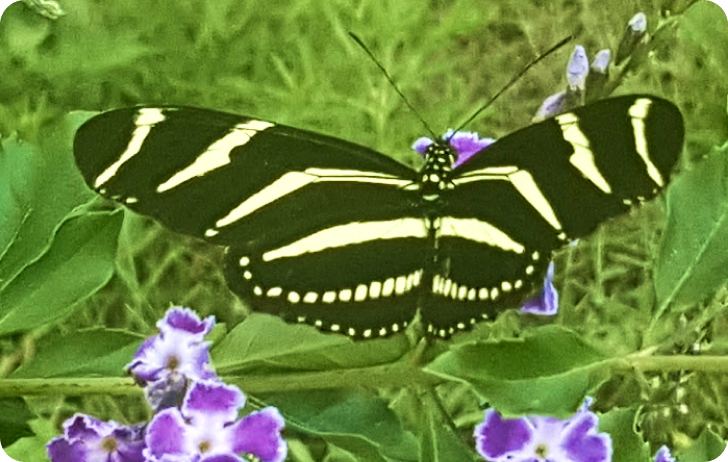
The Heliconius Charithonia or as it is most commonly called the Zebra Longwing is a neotropical butterfly known for its black elongated wings with striking yellow stripes. The underside of the wings has a similar pattern but is paler in color and features several small red spots near its narrow body.
Distribution in Florida
The zebra longwing graces regions from the southern parts of the United States down to Central America.
Where to Find Zebra Longwing in Florida
the Zebra Longwing is commonly found in subtropical hammocks, forest margins, shrubby thickets, and adjacent open areas. It's also a regular sight in many butterfly gardens, suburban yards, and parks.
Lifecycle
Egg
The life of a Zebra Longwing begins as a tiny, pinhead-sized egg laid by the female butterfly on the undersides of passion vine leaves. These pale yellow and oval-shaped eggs are strategically placed to ensure the emerging caterpillar has immediate access to food. The egg stage lasts for about 3 to 5 days. During this time, the egg will darken as the caterpillar inside prepares to emerge.
Caterpillar
Caterpillars of this species are white with black spots and adorned with black spines. Like all butterflies, the Zebra Longwing caterpillar goes through five instar stages. Each instar is a phase between molts, where the caterpillar sheds its skin to accommodate its growing body.
First Instar:
After hatching from the egg, the first instar is tiny, measuring about 2mm in length. It has a pale color and is almost translucent. During this stage, the caterpillar consumes its eggshell as its first meal before moving on to passion vine leaves. Lasts for about 2-3 days.
Second Instar:
As the caterpillar enters its second instar, it starts to develop spines and its color becomes more pronounced. It's during this stage that the caterpillar begins to exhibit the characteristic white and black bands. Lasts for about 2-3 days.
Third Instar:
By the third instar, the caterpillar has grown significantly, reaching up to 8mm in length. The spines become more prominent, and the bands become clearer. The caterpillar's appetite also increases, leading to rapid growth. Lasts for about 2-3 days.
Fourth Instar:
In the fourth instar, the caterpillar's length can range between 15-20mm. Its spines are now more colorful, often with a hint of orange or yellow. The caterpillar continues to feed voraciously, preparing for the final instar. Lasts for about 2-3 days.
Fifth Instar:
This is the final stage before the caterpillar prepares to pupate. It can grow up to 30mm in length. The bands are now very distinct, and the spines are fully developed. Once it has reached its maximum size, the caterpillar will find a safe spot to begin its transformation into a chrysalis. Lasts for about 3-4 days.
Chrysalis
Formation of the Chrysalis
After the caterpillar reaches its final instar and has consumed enough food, it seeks a sheltered spot to pupate. The caterpillar spins a silk pad, attaching itself using its rear end. It then hangs upside down in a 'J' shape, a position known as "pre-pupal." As the transformation begins, the caterpillar's skin splits, revealing the chrysalis beneath. This process is relatively quick, often completed within a day.
What does the Zebra Longwing Butterfly Chrysalis look like?
The Zebra Longwing chrysalis is typically elongated and somewhat slender. Its color can vary, often influenced by environmental factors, but it generally ranges from a pale green to a more brownish hue. This coloration helps camouflage the chrysalis, protecting it from potential predators.
How long does the Zebra Longwing stay in the Chrysalis?
The Zebra Longwing remains in its chrysalis for about 10 to 15 days, depending on environmental conditions. During this time, you can sometimes see the developing wing patterns through the chrysalis's outer shell as the butterfly nears the time of emergence.
Adult Behavior
Lifespan
Zebra Longwings have a longer lifespan than many other butterfly species, living up to several months. One reason for their extended lifespan is their diet. Apart from nectar, they also consume pollen, which provides them with amino acids, enhancing their longevity.
Roosting
Zebra Longwings have a unique behavior of roosting in groups. As evening approaches, they gather in communal roosts, often returning to the same location night after night. This behavior is believed to offer protection against predators.
Mating and Reproduction
In some populations, males are known to mate with females even before they emerge from their chrysalis, a behavior known as "pupal mating." After mating, females lay their eggs on the terminal leaves and tendrils of Passionvines. As the caterpillar consumes the leaves, it matures and eventually forms a chrysalis. This chrysalis then gives birth to the adult butterfly. They have been observed to exhibit selective oviposition, choosing specific plants or leaves that might offer the best chances of survival for their offspring.
How to tell Male from Female
Males of the species are slightly smaller with brighter yellow bands on their wings, while the females are larger with paler yellow bands.
Migration
Zebra Longwings can exhibit local migratory behaviors, especially in response to changes in food availability or weather conditions.
Table of Contents
- Egg
- Caterpillar
- Chrysalis
- Adult Behavior
- How to Raise
Family:
Nymphalidae
Common Names:
Zebra Heliconian
Size:
Wingspan 2.7 and 4 inches (72-100mm).
Host Plant:
Passion Vine
Conservation Status:
As of now, the Zebra Longwing Butterfly is not classified as endangered or threatened.
Did you know?
This Zebra Longwing Butterfly produces a creaking sound if disturbed by wiggling its body.
How fast can a Zebra Longwing fly?
Their flight is slow, graceful, and gives off a floaty ambiance.
Did you know?
Zebra Longwings have a longer lifespan than many other butterfly species, living up to several months. One reason for their extended lifespan is their diet. Apart from nectar, they also consume pollen, which provides them with amino acids, enhancing their longevity.
Predators and Threats
Birds, spiders, and mantises often prey on them. The striking black and white pattern of the Zebra Longwing serves as a warning to potential predators. They are unpalatable due to toxins they accumulate from their larval host plants, the passion vines.
Did you know?
In 1996 the Zebra Longwing Butterfly became the state butterfly of Florida.